
Kiều Trinh
Behind (the mask), Beneath (the water), Between (two hands)
Die dreiteilige Bilderserie des*der Künstler*in Kiều Trinh beschäftigt sich durch malerischer Auseinandersetzung mit dem eigenen Prozess des reclaiming… wie Herkunft und Tradition Orientierung geben und zugleich fremd wirken können.
Was ist Authentizität, wenn ich mich in stereotypen Vorstellungen zu Hause fühle? Wer bin ich, wenn ich die Geschichte meiner Ahn*innen nur als Andeutungen kenne, aber deren Geschichte auch Spuren von Gewalt in mir hinterlässt? Sind diese als ein Auftrag an mich zu deuten, die Vergangenheit endlich aufzuarbeiten? Die Geister zu konfrontieren?
Behind (the mask): Tổn Thương (Schmerz / emotionale Wunde)
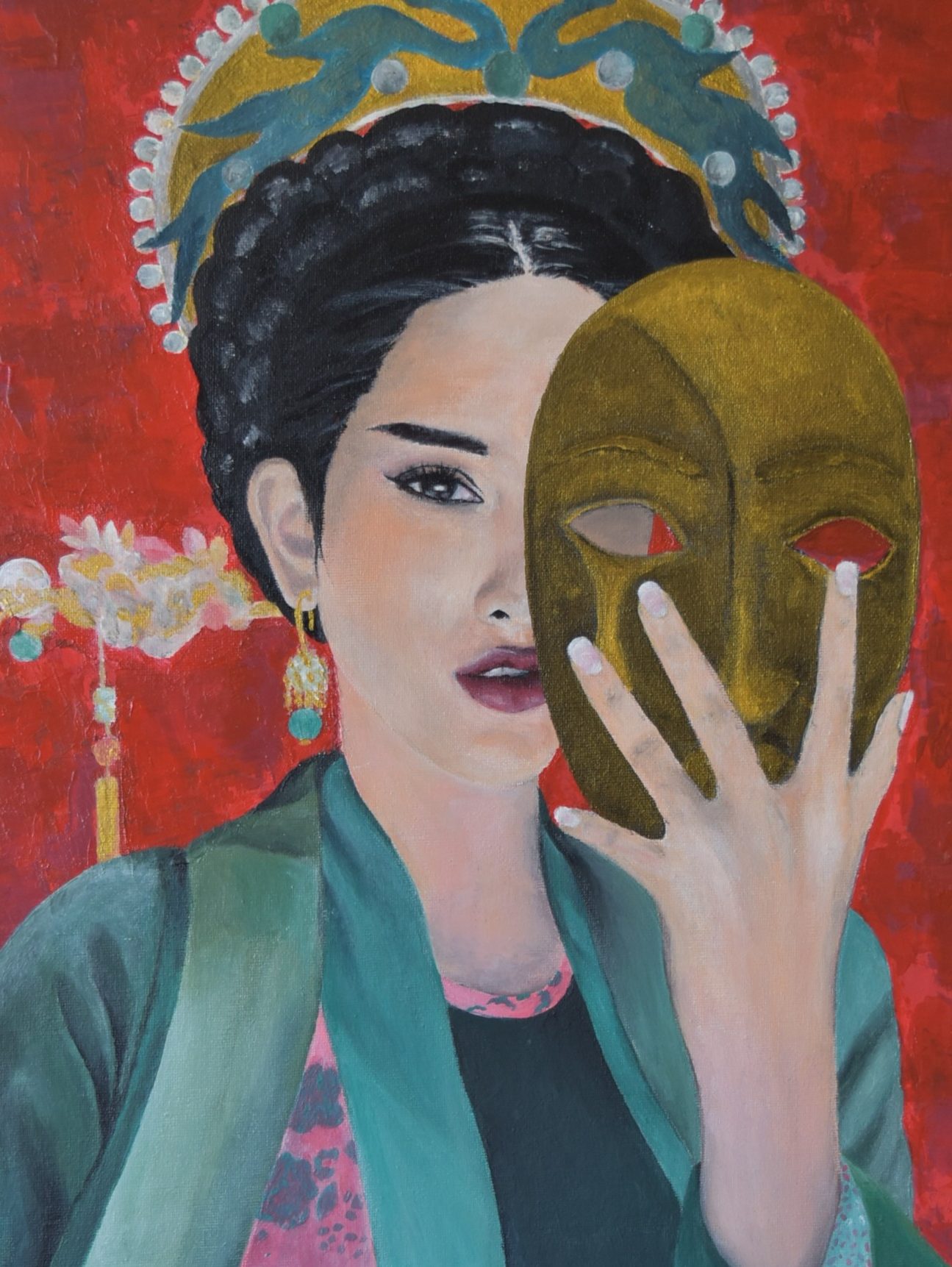
Die Kaiserin mit der goldenen Maske verkörpert eine Herkunft, die spürbar ist und doch fern bleibt.
Beneath (the water): Nỗi Buồn (Tiefe innere Trauer)
Das im Wasser schwebende Gesicht verweist auf über Generationen weitergegebenen Schmerz. Traumata, die nicht ausgesprochen wurden, sinken in den Körper.
Between (two hands): Tự Tin (Selbstvertrauen / Zuversicht)
Im Selbstportrait entscheidet sich der*die Künstler*in für sich und deren authentisches selbst - mit dem Schmuck der Mutter und der Áo Dài als
eigenen Zugang. Was entsteht, wenn mit den eigenen Händen Vergangenheit gehalten und Zukunft neu geformt wird?
Die Gemälde sind basierend auf dem Musikvideo "Tự Tâm" von Nguyễn Trần Trung Quân und den Fotografien von Denisse Ariana Pérez und Merve Aglamaz
ENGLISH
he three-part painting series by the artist Kiều Trinh, a non-binary artist, explores, through painterly engagement, the process of reclaiming… how origin and tradition can both provide guidance and feel foreign.
What is authenticity, if Trinh feels at home within stereotypical notions? Who is Trinh, when Trinh knows ancestors’ stories only in fragments, yet their histories leave traces of violence within? Should these be interpreted as a call for Trinh to finally work through the past? To confront the spirits?
Behind (the mask): Tổn Thương (Pain / emotional wound)
The empress with the golden mask embodies an origin that is tangible yet distant.
Beneath (the water): Nỗi Buồn (Deep inner sorrow)
The face floating in the water refers to intergenerational pain. Unspoken traumas sink into the body.
Between (two hands): Tự Tin (Self-confidence / assurance)
In the self-portrait, Trinh chooses themselves and their authentic self - using their mother’s jewelry and the Áo Dài as a personal approach. What emerges when one holds the past in their own hands and reshapes the future?
The paintings are based on the music video “Tự Tâm” by Nguyễn Trần Trung Quân and the photographs by Denisse Ariana Pérez and Merve Aglamaz.
TIẾNG VIỆT
Bộ ba tranh của nghệ sĩ Kiều Trinh, khám phá, thông qua cách vẽ, quá trình tự khẳng định lại bản thân (reclaiming)… cách mà nguồn gốc và truyền thống vừa định hướng, vừa có thể trở nên xa lạ.
Thế nào là sự chân thực, khi Trinh cảm thấy quen thuộc trong những khuôn mẫu? Trinh là ai, khi chỉ biết lịch sử của tổ tiên qua những gợi ý nhưng những câu chuyện đó vẫn để lại dấu vết bạo lực trong Trinh? Liệu đây có phải là lời nhắn nhủ để Trinh cuối cùng phải giải quyết quá khứ? Đối diện với những linh hồn đó?
Behind (the mask): Tổn Thương (nỗi đau / vết thương tinh thần)
Nữ hoàng với chiếc mặt nạ vàng thể hiện một nguồn gốc vừa cảm nhận được, vừa xa xôi.
Beneath (the water): Nỗi Buồn (nỗi buồn sâu thẳm bên trong)
Gương mặt trôi nổi trong nước gợi nhớ những nỗi đau được truyền qua nhiều thế hệ. Những sang chấn chưa được nói ra chìm vào cơ thể.
Between (two hands): Tự Tin (sự tự tin / hy vọng)
Trong chân dung tự họa, Trinh chọn bản thân và cái tôi chân thực của mình - với trang sức của mẹ và áo dài như một lối tiếp cận riêng. Điều gì xảy ra khi chính đôi tay mình ôm giữ quá khứ và tạo hình tương lai?
Các bức tranh dựa trên video ca nhạc “Tự Tâm” của Nguyễn Trần Trung Quân và các bức ảnh của Denisse Ariana Pérez và Merve Aglamaz.

Biografie
Kiều Trinh ist eine nicht-binäre Dichter*in und Künstler*in, deren Arbeit persönliche und spirituelle Themen auf kreative Weise verbindet - inspiriert von Zen-Buddhismus, Daoismus und dekolonialem Denken. In Gemälden und literarischen Texten setzt sich Kiều Trinh mit Fragen von Identität, Queerness und Herkunft auseinander. Kiều Trinhs Werke kreisen um Selbstverortung, inneren Wandel und das Miteinander in einer komplexen Welt. In klarer Prosa und tiefgehenden Tagebucheinträgen gibt Kiều Trinh Einblicke in emotionale Prozesse, spirituelle Erfahrungen und gesellschaftliche Fragestellungen. Das Publikum ist eingeladen, Kiều Trinh auf dieser vielschichtigen Reise zwischen Persönlichem und Politischem, Körper und Geist, Sichtbarem und Unsichtbarem zu begleiten.
ENGLISH
Kiều Trinh is a non-binary poet and artist whose work creatively combines personal and spiritual themes, inspired by Zen Buddhism, Daoism, and decolonial thinking. In paintings and literary texts, Trinh explores questions of identity, queerness, and origin.
Trinh’s works revolve around self-positioning, inner transformation, and relationships in a complex world. Through clear prose and in-depth diary entries, Trinh offers insights into emotional processes, spiritual experiences, and societal issues.
Audiences are invited to join Trinh on this layered journey between the personal and the political, body and mind, the visible and the invisible.
TIẾNG VIỆT
Kiều Trinh là một nhà thơ và nghệ sĩ non-binary, người kết hợp sáng tạo các chủ đề cá nhân và tâm linh trong tác phẩm - được truyền cảm hứng từ Thiền tông, Đạo giáo và tư duy phi thực dân. Trong các bức tranh và văn bản văn học, Trinh khám phá những câu hỏi về bản sắc, tính queer và nguồn gốc.
Tác phẩm của Trinh xoay quanh việc định vị bản thân, sự chuyển hóa nội tâm và mối quan hệ với người khác trong một thế giới phức tạp. Bằng ngôn từ trong sáng và các nhật ký sâu sắc, Trinh cho phép người đọc nhìn vào các quá trình cảm xúc, trải nghiệm tâm linh và các vấn đề xã hội.
Khán giả được mời cùng Trinh trải nghiệm hành trình đa tầng giữa cá nhân và chính trị, cơ thể và tinh thần, cái hữu hình và vô hình.